{{ text }}
 It was then collected by the bottom torus, which was connected to the upper one by four large trombone tubes, each of which included a fuel valve. Pyrios uses two increased-thrust and heavily modified F-1B engines per booster. Saturn V SA-510 (Apollo 15) Launched 26 July 1971 (NASA) Rocketdyne F-1 Engines. Rocketdyne presented the results of this study to the Air Force in 1957 and the Air Force told Rocketdyne to go build one. Hope this is an acceptable question. Thats more than 12 million horsepower. The 12 Apollo flights used 60 engines and Skylab used another 5. In general, inducers have a minimal effect on the efficiency and head of the pump but offer a dramatic impact on the cavitation performance. Cavitation instabilities that can trigger severe load and vibrations within turbopumps cause engine thrust fluctuations and sometimes even total mechanical failure. A car engine generates about half a single horsepower to each pound of engine weight. Turbopumps help rockets achieve high power to weight ratio by feeding pressurized propellant to the rockets combustion chamber. Published 23 Jun 2021. According to Forbes, there are 10,000 space companies globally. Powerhouse Museum. 6. Pressurized tanks tend to be heavy and bulky and are less preferred since they add to the overall rocket system weight. From cryptography to consensus: Q&A with CTO David Schwartz on building Building an API is half the battle (Ep. Suppression can be done by using an obstruction plate or by connecting a smaller diameter suction pipe upstream of the inducers. This engine was constructed in 1963 by the Rocketdyne Division of Rockwell International and underwent four start tests, totaling 192.6 seconds. The RS-25 high pressure fuel turbopump generates 100 horsepower for each pound of its weight. producing 55,000 brake horsepower (41 MW). Going farther requires going faster. The F-1, commonly known as Rocketdyne F1, was a rocket engine developed by Rocketdyne. Clearly, extensive development was going to be required. Below the thrust chamber was the nozzle extension, roughly half the length of the engine. ", "NASA sees no problem recovering Apollo engines", "NASA Administrator Supports Apollo Engine Recovery", "Apollo Mission Rocket Engines Recovered", "Billionaire Jeff Bezos Talks About His Secret Passion: Space Travel", Saturn V Launch Vehicle, Flight Evaluation Report, AS-510, Technical Manual R-3896-1: Engine Data F-1 Rocket Engine, Technical Manual R-3896-3 Volume I: Maintenance and Repair F-1 Rocket Engine, Technical Manual R-3896-3 Volume II: Maintenance and Repair F-1 Rocket Engine, Technical Manual R-3896-4: Illustrated Parts Breakdown F-1 Rocket Engine, Technical Manual R-3896-5 Volume I: Ground Support Equipment and Repair F-1 Rocket Engine, Technical Manual R-3896-5 Volume II: Ground Support Equipment Maintenance and Repair F-1 Rocket Engine, Technical Manual R-3896-6: Installation and Repair of Thermal Insulation F-1 Rocket Engine, Technical Manual R-3896-9: Transportation F-1 Rocket Engine, Technical Manual R-3896-11: F-1 Rocket Engine Operating Instructions, NASA SP-4206 Stages to Saturn - the official NASA history of the Saturn launch vehicle, The Saturn V F-1 Engine: Powering Apollo into History, Remembering The Giants: Apollo Rocket Propulsion Development, How NASA brought the monstrous F-1 moon rocket engine back to life, New F-1B rocket engine upgrades Apollo-era design with 1.8M lbs of thrust, Anthony Young Collection, The University of Alabama in Huntsville Archives and Special Collections, Primary guidance, navigation, and control system, Charged Particle Lunar Environment Experiment, https://en.wikipedia.org/w/index.php?title=Rocketdyne_F-1&oldid=1141658122, Rocket engines using the gas-generator cycle, Short description is different from Wikidata, Articles needing additional references from July 2009, All articles needing additional references, Articles with unsourced statements from February 2023, Articles containing potentially dated statements from 2013, All articles containing potentially dated statements, Wikipedia articles in need of updating from January 2015, All Wikipedia articles in need of updating, Creative Commons Attribution-ShareAlike License 3.0, Thrust (average, per engine, sea level liftoff): 1,553,200lbf (6.909MN), * Different versions of the engine use different propellant combinations, This page was last edited on 26 February 2023, at 04:28. In 2013, engineers at the Marshall Space Flight Center began tests with an original F-1, serial number F-6049, which was removed from Apollo 11 due to a glitch. If you could slow time and examine what happened during one of those magnificent operational seconds, what would you find? Rather than seeking a direct analytical answer to this question, they chose instead to select the largest thrust anyone could imagine and do the preliminary design for an engine that could achieve that thrust.
 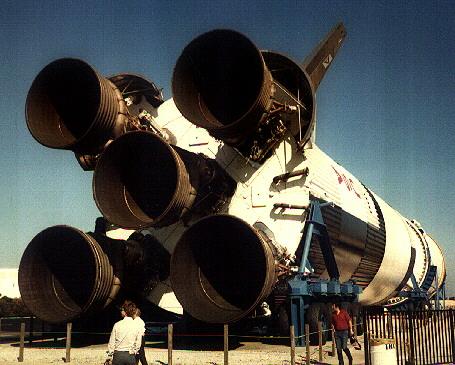 Each of the bell-shaped F-1 engines weighed over nine tons, generated 1.5 million pounds of thrust, and had a potential energy output equal to the power of eighty-five Hoover dams. The Saturn V could have never achieved its objective of sending humans to Earths moon were it not for the F-1 engine. 552), Improving the copy in the close modal and post notices - 2023 edition. Chamber pressure of the F1 on SaturnV was 1015psi and the chamber pressure for the upcoming Raptor engine is 4351psi (300 bar). Once an additional 83 seconds have expired, at an altitude of 42 miles, traveling at 6,160 mph, the S-IC component containing the fuel tanks and five F-1 engines will be shed from the rest of the Saturn V, momentum carrying the booster a further 31 miles in altitude. This project called for the design and development of a reliable turbopump with decreased recurring costs. [citation needed], During the 1960s, Rocketdyne undertook uprating development of the F-1 resulting in the new engine specification F-1A. Notify me of follow-up comments by email. , William Alarik Sorensen et al., MS Thesis, Massachusetts Institute of Technology, September 2014. The reduction in parts costs is aided by using selective laser melting in the production of some metallic parts. A gas generator was used to drive a turbine which drove separate fuel and oxygen pumps, each feeding the thrust chamber assembly. One Second in the Life of the Rocketdyne F-1 Rocket Engine https://www.enginehistory.org/Rockets/RPE08.11/RPE08.11.shtml This scheme was fortunately scrapped early before it was ever tested. Plaque at the memorial and observations. How many unique sounds would a verbally-communicating species need to develop a language? Numerical and experimental study of cavitating flow through an axial inducer considering tip clearance, Rafael Campos-Amezcua et al., Proc IMechE Part A: J Power and Energy 227(8) 858868, IMechE 2013. producing 55,000 brake horsepower (41 MW). with questions or comments about this web site. WebThe Merlin 1B rocket engine was an upgraded version of the Merlin 1A engine. Each F-1 engine had more thrust than three Space Shuttle Main Engines combined. These had to be removed from the engine to avoid problems during engine handling and future firing, and the solvent trichloroethylene (TCE) was used to clean the engine's fuel system immediately before and after each test firing. In this one second, the gas generator that supplies the turbopump has consumed 17.5 gallons of RP-1 fuel through a 2 inch diameter pipe, and 5.1 gallons of oxidizer through a 1 inch diameter pipe to combust and drive the two-stage impulse turbine containing 109 blades in the 33-inch diameter first stage and 119 blades in the 35-inch diameter second stage rotor. Each F-1 was tested individually for a 40-sec calibration run and a 165-sec mission duration test. Even if they occur, their amplitudes are weakened and subdued by the suppression devices. David. The first static firing of a full-stage developmental F-1 was performed in March 1959. These 65 flight engines were all 100% successful. On May 20, 2017 the Apollo permanent exhibit opened at the Museum of Flight in Seattle, WA and displays engine artifacts recovered including the thrust chamber and thrust chamber injector of the number 3 engine from the Apollo 12 mission, as well as a gas generator from an engine that powered the Apollo 16 flight. F-1 engine F-6049 is displayed vertically at the Museum of Flight in Seattle, Washington as part of the Apollo exhibit. External access to NAS behind router - security concerns? Reports indicate that nearly 59 % of rocket launch failures are due to propulsion system failures. He also insisted this should be accomplished by scaling up existing ballistic missile technology to produce a conservative design reliable enough for human flight. It has to handle temperatures as low as minus 400 degrees where the propellants enter the engine and as high as 6,000 degrees as the exhaust exits the combustion chamber where the propellants are burned. Early development tests revealed serious combustion instability problems which sometimes caused catastrophic failure. 5, Sep-Oct 1993). An F-1 engine is installed vertically as a memorial to the Rocketdyne builders on De Soto across the street from the old Rocketdyne plant in Canoga Park, California. ";s:7:"keyword";s:37:"f1 rocket engine turbopump horsepower";s:5:"links";s:663:"Turkish Restaurant San Diego Downtown,
Carey Jean Bollinger,
Failure To Maintain Nursing License Requirements In Virginia,
Checkbox Background Color Not Changing,
Brandon Police Reports,
Articles F
Each of the bell-shaped F-1 engines weighed over nine tons, generated 1.5 million pounds of thrust, and had a potential energy output equal to the power of eighty-five Hoover dams. The Saturn V could have never achieved its objective of sending humans to Earths moon were it not for the F-1 engine. 552), Improving the copy in the close modal and post notices - 2023 edition. Chamber pressure of the F1 on SaturnV was 1015psi and the chamber pressure for the upcoming Raptor engine is 4351psi (300 bar). Once an additional 83 seconds have expired, at an altitude of 42 miles, traveling at 6,160 mph, the S-IC component containing the fuel tanks and five F-1 engines will be shed from the rest of the Saturn V, momentum carrying the booster a further 31 miles in altitude. This project called for the design and development of a reliable turbopump with decreased recurring costs. [citation needed], During the 1960s, Rocketdyne undertook uprating development of the F-1 resulting in the new engine specification F-1A. Notify me of follow-up comments by email. , William Alarik Sorensen et al., MS Thesis, Massachusetts Institute of Technology, September 2014. The reduction in parts costs is aided by using selective laser melting in the production of some metallic parts. A gas generator was used to drive a turbine which drove separate fuel and oxygen pumps, each feeding the thrust chamber assembly. One Second in the Life of the Rocketdyne F-1 Rocket Engine https://www.enginehistory.org/Rockets/RPE08.11/RPE08.11.shtml This scheme was fortunately scrapped early before it was ever tested. Plaque at the memorial and observations. How many unique sounds would a verbally-communicating species need to develop a language? Numerical and experimental study of cavitating flow through an axial inducer considering tip clearance, Rafael Campos-Amezcua et al., Proc IMechE Part A: J Power and Energy 227(8) 858868, IMechE 2013. producing 55,000 brake horsepower (41 MW). with questions or comments about this web site. WebThe Merlin 1B rocket engine was an upgraded version of the Merlin 1A engine. Each F-1 engine had more thrust than three Space Shuttle Main Engines combined. These had to be removed from the engine to avoid problems during engine handling and future firing, and the solvent trichloroethylene (TCE) was used to clean the engine's fuel system immediately before and after each test firing. In this one second, the gas generator that supplies the turbopump has consumed 17.5 gallons of RP-1 fuel through a 2 inch diameter pipe, and 5.1 gallons of oxidizer through a 1 inch diameter pipe to combust and drive the two-stage impulse turbine containing 109 blades in the 33-inch diameter first stage and 119 blades in the 35-inch diameter second stage rotor. Each F-1 was tested individually for a 40-sec calibration run and a 165-sec mission duration test. Even if they occur, their amplitudes are weakened and subdued by the suppression devices. David. The first static firing of a full-stage developmental F-1 was performed in March 1959. These 65 flight engines were all 100% successful. On May 20, 2017 the Apollo permanent exhibit opened at the Museum of Flight in Seattle, WA and displays engine artifacts recovered including the thrust chamber and thrust chamber injector of the number 3 engine from the Apollo 12 mission, as well as a gas generator from an engine that powered the Apollo 16 flight. F-1 engine F-6049 is displayed vertically at the Museum of Flight in Seattle, Washington as part of the Apollo exhibit. External access to NAS behind router - security concerns? Reports indicate that nearly 59 % of rocket launch failures are due to propulsion system failures. He also insisted this should be accomplished by scaling up existing ballistic missile technology to produce a conservative design reliable enough for human flight. It has to handle temperatures as low as minus 400 degrees where the propellants enter the engine and as high as 6,000 degrees as the exhaust exits the combustion chamber where the propellants are burned. Early development tests revealed serious combustion instability problems which sometimes caused catastrophic failure. 5, Sep-Oct 1993). An F-1 engine is installed vertically as a memorial to the Rocketdyne builders on De Soto across the street from the old Rocketdyne plant in Canoga Park, California. ";s:7:"keyword";s:37:"f1 rocket engine turbopump horsepower";s:5:"links";s:663:"Turkish Restaurant San Diego Downtown,
Carey Jean Bollinger,
Failure To Maintain Nursing License Requirements In Virginia,
Checkbox Background Color Not Changing,
Brandon Police Reports,
Articles F